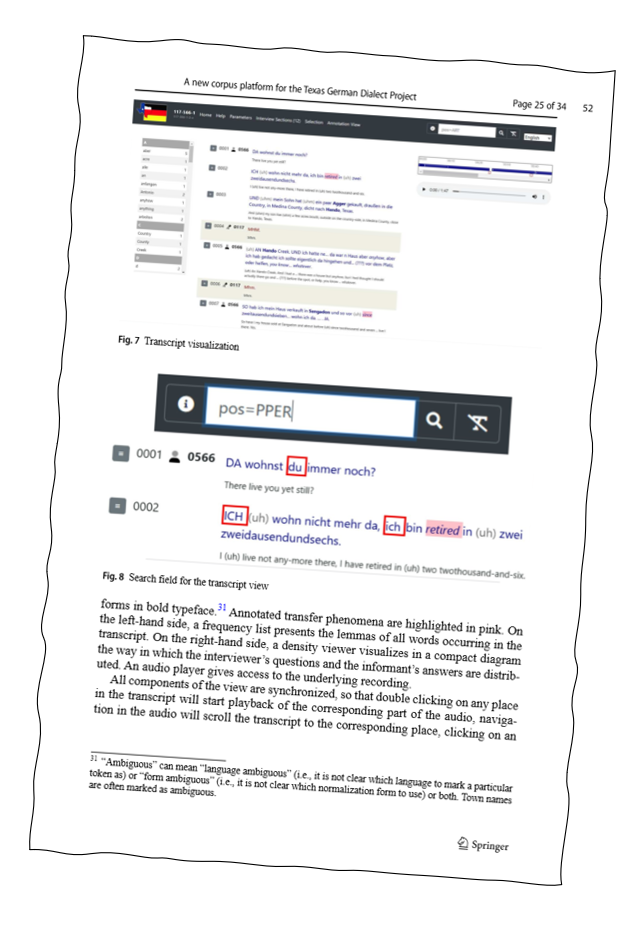
Our work on setting up a ZuMult Instance for the Texas German Dialect Project (TGDP) is the topic of a paper recently published in Language Resources & Evaluation:
Boas, Hans C., Schmidt, Thomas & Blevins, Margo (2026). A new corpus platform for the Texas German Dialect Project. Language Resources & Evaluation 60 (52). Springer.
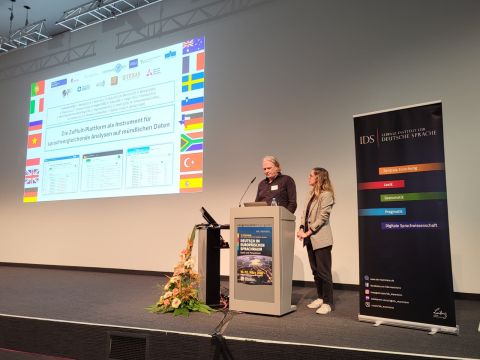
Schmidt, T., Abouda, L., Badin, F., Boas, H. C., Blevins, M., Bührig, K., Dugua, C., Fandrych, C., Ferger, A., Frick, E., Kompiel, P. A., Miecznikowski-Fuenfschilling, J., Pagenstecher, C., Pitsch, K., Schwendemann, M., Skrovec, M., Verdonik, D., Wallner, F., & Wörner, K. (2026). Die ZuMult-Plattform als Instrument für sprachvergleichende Analysen auf mündlichen Daten. 62. Jahrestagung des Leibniz-Instituts für Deutsche Sprache: Deutsch im europäischen Sprachraum — Stand und Perspektiven, Mannheim. Zenodo. https://doi.org/10.5281/zenodo.18983100
Lösel, A., Messner, A., Schwendemann, M., & Wallner, F. (2026). ExpoKo – Werkzeug und Ressource für das wissenschaftliche Schreiben. 62. Jahrestagung des Leibniz-Instituts für Deutsche Sprache. Deutsch im europäischen Sprachraum – Stand und Perspektiven, Mannheim. Zenodo. https://doi.org/10.5281/zenodo.19115807
UT Austin and linguisticbits.de have released a new version of the ZuMult platform for the 𝗧𝗲𝘅𝗮𝘀 𝗚𝗲𝗿𝗺𝗮𝗻 𝗗𝗶𝗮𝗹𝗲𝗰𝘁 𝗽𝗿𝗼𝗷𝗲𝗰𝘁 (TGDP). Besides additional transcribed interviews from the TGDP, an additional annotation layer for Universal Dependency POS tags, and a couple of improvements to the frontend (streamlined navigation, improvements to the KWIC display and more), this new version also contains the „𝗵𝗶𝘀𝘁𝗼𝗿𝗶𝗰𝗮𝗹“ 𝗶𝗻𝘁𝗲𝗿𝘃𝗶𝗲𝘄𝘀 𝗰𝗼𝗻𝗱𝘂𝗰𝘁𝗲𝗱 𝗯𝘆 𝗚𝗹𝗲𝗻𝗻 𝗚𝗶𝗹𝗯𝗲𝗿𝘁 𝗶𝗻 𝘁𝗵𝗲 𝟭𝟵𝟲𝟬𝘀 with speakers of Texas German. This adds a diachronic dimension to the study of Texas German.
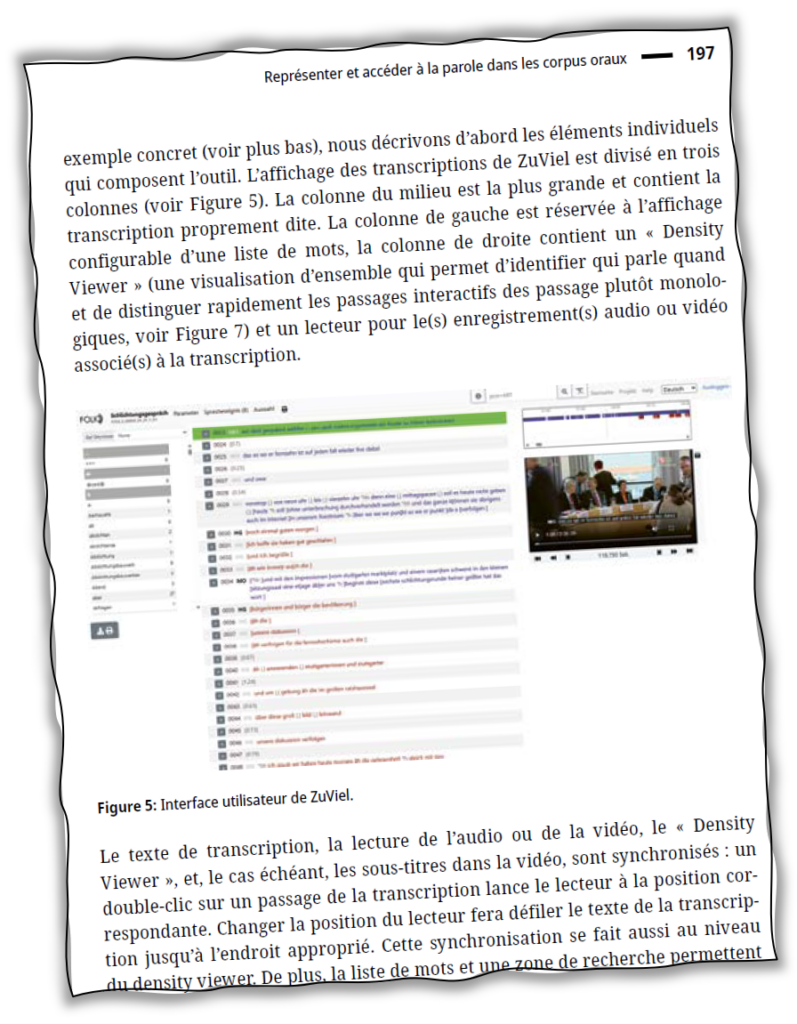
The first French publication on ZuMult has recently been published:
Schmidt, Thomas (2025): Représenter et accéder à la parole dans les corpus oraux : diversification et adaptation des méthodes et technologies. Représenter la parole: Apports à une dimension fondamentale de la linguistique, edited by Layal Kanaan-Caillol, Céline Dugua and Annette Gerstenberg, De Gruyter, 2026, pp. 185-208.
Elena Frick and Thomas Schmidt’s publication on querying spoken language data is out. It gives an overview of different approaches to querying spoken language corpora and uses ZuMult as one way of illustration.
Frick, Elena and Schmidt, Thomas (2025). „Querying spoken language data“. Harmonizing language data: Standards for linguistic resources, edited by Piotr Bański, Ulrich Heid and Laura Herzberg, De Gruyter, 2025, pp. 339-376.
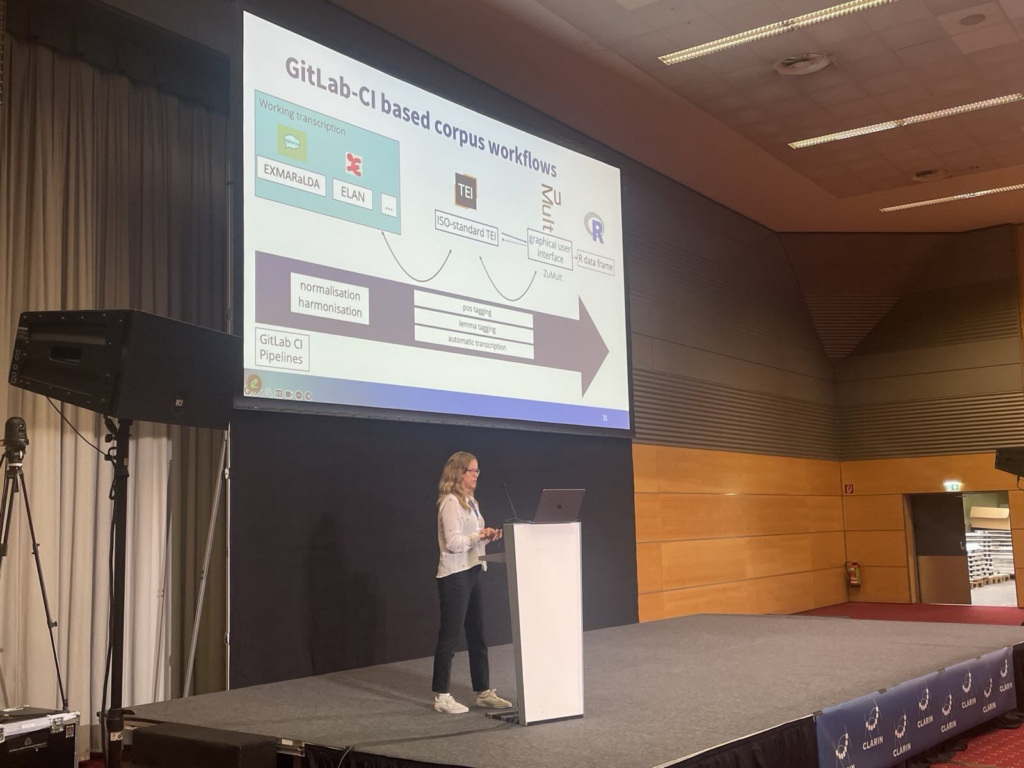
On October 1st, Anne Ferger and Thomas Schmidt presented ZuMult at the CLARIN Annual Conference 2025 in Vienna. A special emphasis of the presentation was on the way in which ZuMult builds on existing, established standards, practices and technology. The title of the talk reflected this with a reference to Monty Python:
ExpoKo – eine Korpusressource für das wissenschaftliche Schreiben (Elena Frick, Andrea Lösek, Annalena Messner, Thomas Schmidt, Matthias Schwendemann, Franziska Wallner) introduced the ExpoKo corpus, a growing collection of student exposés, mostly written by students with German as a second language. The corpus will be made available for research into learner corpora and German as a foreign language via a ZuMult instance. An abstract and the poster itself are available on Zenodo: https://doi.org/10.5281/zenodo.17207105
ZuMult – Ein Multi-Tool für den didaktischen und linguistischen Zugang zu Korpora (Christian Fandrych, Anne Ferger, Elena Frick, Karola Pitsch, Thomas Schmidt, Matthias Schwendemann, Franziska Wallner) gave an overview of the platform itself focusing on its use for learner corpora and introducing some recent developments. An abstract and the poster itself are available on Zenodo: https://doi.org/10.5281/zenodo.17205428
As part of the International Workshop of Embodied Interaction & Embodied Intelligence [EC]² in Essen on August 21st and 22nd, Thomas Schmidt, Anne Ferger, Felix Bergmann and Karola Pitsch presented a work-in-progress report on the ZuMult installation at the University of Duisburg-Essen.
The talk was titled Complex Interactional Corpora: Workflows and Platform for video-based Studies of Embodied Interaction and Human-Machine Interaction and introduced an international audience of interaction and human-machine communication researchers to GI-based workflows and the ZuMult platform.